Readings
The Ultimate Display
This article is fairly interesting in how it questions the current level of interaction that we have with computers. How our controlling of their systems and processes is typically limited to just what we type and click on. I guess it truly is possible that any part of our body has the potential to be a control input for computers. This further immersing of more parts of our body into the communication between man & computer brings up the question of how much does man wish to be intertwined with technology? If every technological possibility is utilized, man has every possibility to cross the realm into cyborg territory.
In other scenarios, I think the idea that we can use these displays to go beyond the physical restraints of our 3d world is quite interesting. If mathematics can produce it, our computers can display it. This makes me wonder though, when will the time come that our computers become more advanced than our 3d reality? Will they transgress our current notions of 3d space and time? If the complexity of these displays becomes greater than that of the real world, is it possible to create entire other worlds? Or possibly technology will never be able to match the realness and depth that our current world sustains.
(Hu)man-Computer Symbiosis
This text to me felt like the love story between a human brain and a computer. It is to combine the creative brain of a human with the clerical mind of a computer. The combination of a preprogrammed computer with a contingent brain is highlighted to be the perfect relationship.
I believe that the section with all of the issues that we come across in the further development of this man-computer relationship is quite informative, however possibly a bit too analytical in comparison to the rest of the article.
Because the human brain has already evolved and will stay similar for many years, it is our job to then make computers more and more like us, in order that our relationship with them is more natural and efficient. By making computers more like us, we get rid of problems that arise with speed mismatches, and language difficulties. By making more similar, we highlight the uniqueness of man in combination with the reliability of machines.
A Survey of Augmented Reality
This article was very informative about the technologies of AR, as well as their limitations and applications. This text gave a great idea of what AR is currently being used to accomplish as well as where we can take this technology in the future. Starting AR technologies for the first time, it is extremely comprehensive to understand what technologies we have to work with before diving into the world of AR.
In regards to the different types of displays, I think the most efficient and applicable is to aim towards optical see-through for future developments. It will preserve the integrity of the surrounding physical world while adding on any AR elements that are needed.
In regards to navigation and orientation, which is essential for the application of AR fundamentals onto our reality, I think a combination of optical cues as well as GPS tracking will provide an easy, accurate way to load the correct visuals.
For many of the applications of AR, I had no idea that we had even come to that level of technological advancement. For example, the fact that BMW is currently using AR to assist in welding processes is amazing. Also, being able to use AR to assist surgeons with medical treatments is insane. All of these applications are news to me as whenever I thought of AR, only entertainment purposes came to mind.
The one thing this article does mention is the fear of over-reliance, however, I believe society is far from that stage as AR is still slowly making its way into common society. Like any technology, people will need time to become comfortable with it, but once this stage of comfort is accomplished, I’m sure people will appreciate the functionality of AR.
Augmenting Exercise 1
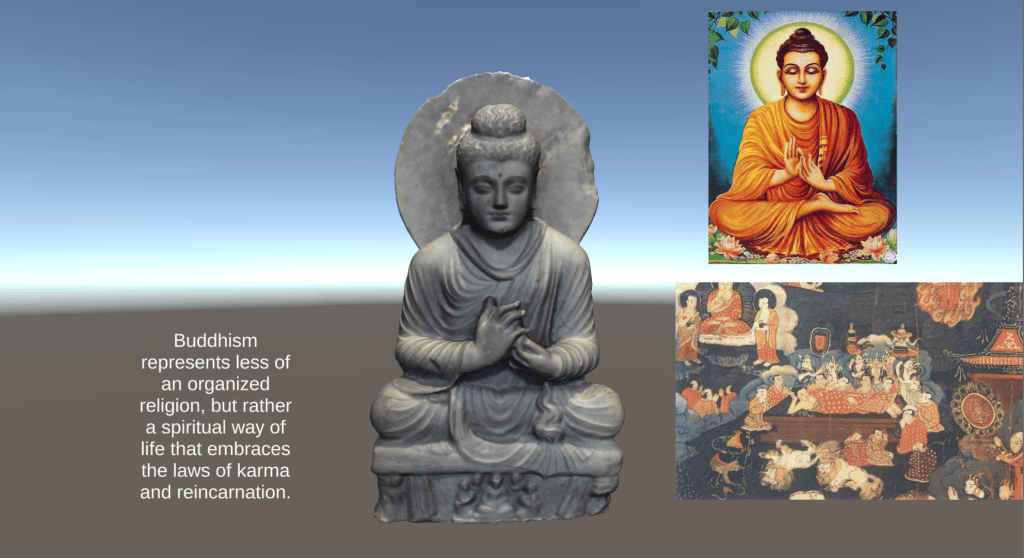
For my augmenting exercise, I chose to experiment with the Buddha sculpture and include a lot of interesting facts about The Buddha as well as the Buddhist religion. I first placed in my model and all of my text and images accordingly in the positions that I desired. Then, for every text component, I created a timer code that would write in the text once the timer reaches a certain number. This allows for each text object to be activated by a timer code at every interval that I wish.
The next step was learning to incorporate the images into my small presentation on the Buddha statue. At first I had difficulties with incorporating images because I would uncheck their box, and then try to “engage” them with the same timer code that I used for the text objects. However, this unchecking of the box actually rendered each image completely void from the Unity preview. With some extra help, I was able to realize that I must first disengage the images in the setup code and then re-engage them at the time interval that I wish.
I set up my text and images to surround the Buddha and as I’m not sure yet how to get my objects to disappear from the code, I strategically placed my images to cover up the text after a certain interval so that the audience’s attention is diverted to the most recent blurb of information. This allows all of the information to be read sequentially. Overall, I think my outcome was clean and accomplished everything I wish, however, I do want to learn how to make my objects in Unity disappear from the screen.
Video:
https://drive.google.com/file/d/1quR0TbhweXrDypWCZMPQE_5lUYD2zWZg/view?usp=sharing
Unity File:
https://drive.google.com/open?id=1iSIOfFkrklj2xQvtgDAFM2uEcP2YTyR2
Sources:
https://talkativeman.com/buddhist-concept-of-nirvana/
https://owlcation.com/humanities/Karma-and-Rebirth/
https://labyrinth-institute.com/the-middle-way-finding-the-balance-for-couples/
https://history.com/topics/religion/buddhism/
https://biographics.org/siddhartha-gautama-biography-the-buddha/
 kyle's blog